Histories that are filled with critical absences do not amount to much other than self-satisfying fable. And while much may be learned from fables, history through one set of eyes is misleading and easily creates a bottleneck of one-dimensional identities that cannot develop an accurate view of themselves. All history and personalities that populate those narratives are cocreated and mutually influential, despite the often one-sidedness of the telling.
The interdisciplinary performances, installations, and sculptures of the Ethiopian American artist Tsedaye Makonnen repurpose what we have come to call belief. The symbols, words of love, and signifiers that remain with us because of our belief in their ability to protect us and sustain us, and how we share them, amount to a narrative that zooms out and gives us a critical view of the thing we call ourselves: human. Makonnen’s questions ply previous pathways and agreements and help extend our historical memory from now into future and past directions only visible when we sit with our interdependency. Her oeuvre expands across storied institutions linking medieval northeastern African history to medieval Europe, and connecting technology to the spiritual.
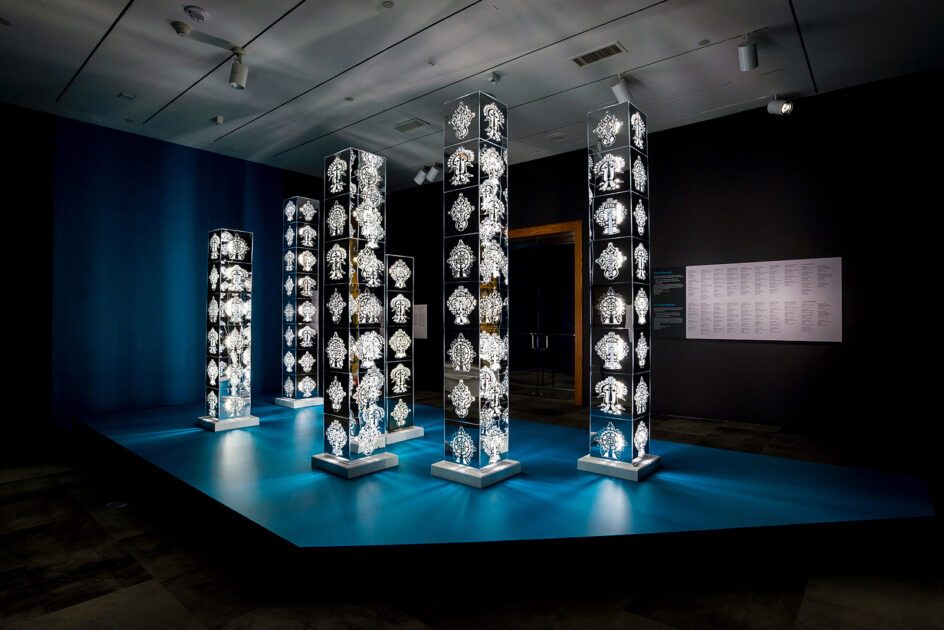
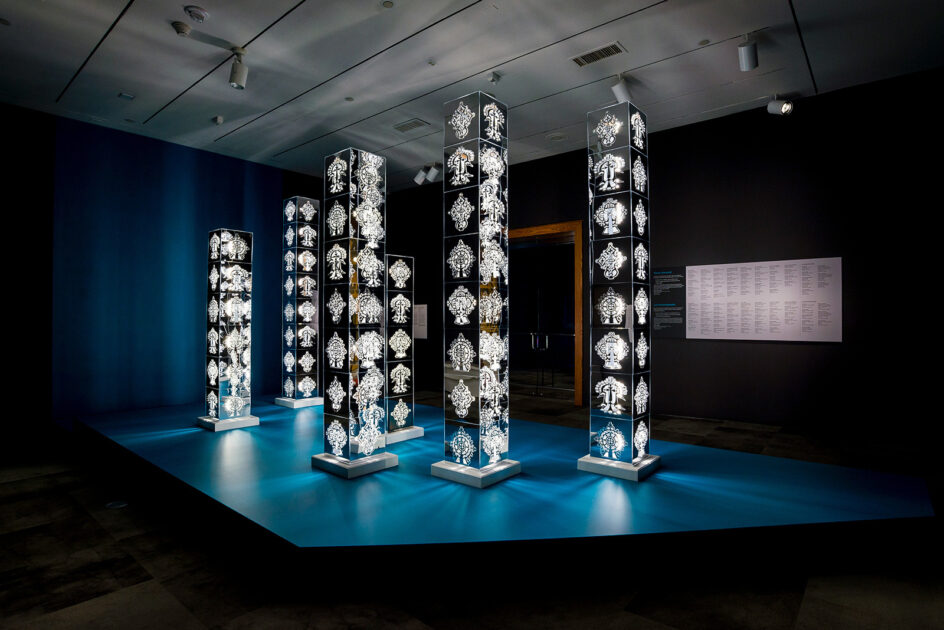
Jessica Lanay I first saw your light sculptures when Steve Gurysh was experimenting with laser cutting at Carnegie Mellon, and I’ve since seen them at the August Wilson African American Cultural Center when they premiered, the Walters Art Museum, and the Metropolitan Museum of Art. What is the meaning of the light sculptures, and how has it changed for you from iteration to iteration?
Tsedaye Makonnen Growing up in an Ethiopian household, I have always been exposed to East African Orthodox crosses; I wear them daily on my body. People tattoo them on themselves. In most households, especially if they’re Orthodox Christian, but even ones that are not, you will see an Ethiopian cross hanging somewhere. Traditionally, they’re made of copper, silver, gold, different metals, even wood. As an artist, I explore it as a material in my practice. I was at a maker residency in the Washington, DC, library, and they paid for me to go study sculpture with El Anatsui when I began this project.
I knew that I wanted to make some type of lighting fixture. I was also really obsessed with lighting design and chandeliers. I had an Ethiopian cross I’d made from ceramic that I used in performances for years prior to that moment; it was falling apart and breaking. I started off with wood, and then I was introduced to acrylic. I knew I wanted a reflective surface; then I was introduced to mirror acrylic. They’re tall because when you’re next to something that’s larger than you, it really kind of puts things in perspective. I want my audience to contemplate their own lives—how universally tiny we are.
My practice is also focused on migration. My parents immigrated here. I saw parallels between the Ethiopian and African American migratory experiences. Black Americans have similar experiences of migrating somewhere completely different, rebuilding their lives, sending money back home to their families. Growing up in DC, Ethiopian and Black American culture talk all the time. The version at the August Wilson African American Cultural Center had crosses named after Black women in the US and sub-Saharan Africa. The top was named after Aiyana Stanley-Jones, who was the youngest person to have been murdered by police.